Event schema
Fields the query expects
| Field | Type | Why it exists |
|---|---|---|
| timestamp_utc | Timestamp | When the processing attempt ended. |
| delivery_id | Utf8 | Stable identifier shared by retry attempts. |
| provider | Utf8 | Webhook provider. |
| event_type | Utf8 | Provider event type. |
| attempt | Int64 | One-based processing attempt. |
| status | Utf8 | success, failed, or deduplicated. |
Copy the query
WITH delivery_outcomes AS (
  SELECT
    delivery_id,
    provider,
    event_type,
    MAX(attempt) AS attempts,
    SUM(CASE WHEN status = 'failed' THEN 1 ELSE 0 END) AS failed_attempts,
    SUM(CASE WHEN status = 'success' THEN 1 ELSE 0 END) AS successful_attempts,
    SUM(CASE WHEN status = 'deduplicated' THEN 1 ELSE 0 END) AS deduplicated_attempts
  FROM webhook_deliveries
  WHERE timestamp_utc >= now() - INTERVAL '7 days'
  GROUP BY delivery_id, provider, event_type
)
SELECT
  provider,
  event_type,
  COUNT(*) AS deliveries,
  SUM(CASE
    WHEN failed_attempts > 0 AND successful_attempts > 0 THEN 1 ELSE 0
  END) AS recovered,
  SUM(CASE
    WHEN failed_attempts > 0 AND successful_attempts = 0 THEN 1 ELSE 0
  END) AS permanent_failures,
  SUM(deduplicated_attempts) AS duplicates_suppressed
FROM delivery_outcomes
GROUP BY provider, event_type
ORDER BY permanent_failures DESC, recovered DESC;
This read-only query is planned and executed against an empty typed table with Apache DataFusion 45.2.0. We review the synthetic sample output separately. Check field types, thresholds, and counting rules against your own data. Read the testing methodology.
Query result
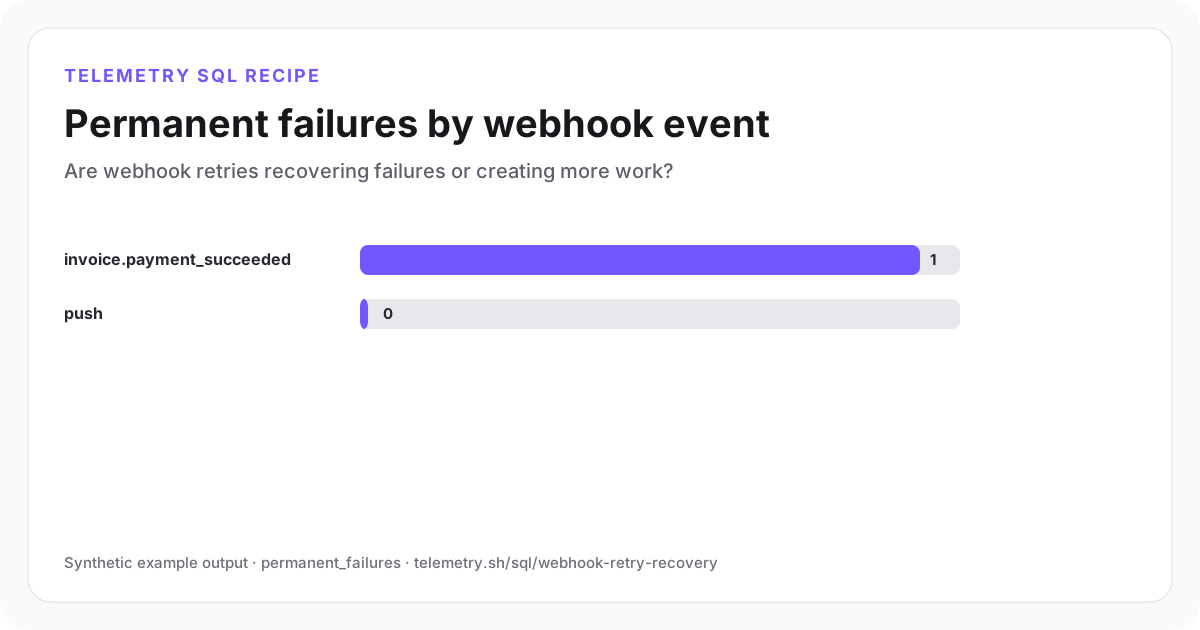
Permanent failures by webhook event
Recovered events remain visible without being counted as permanent customer impact.
| provider | event_type | deliveries | recovered | permanent_failures | duplicates_suppressed |
|---|---|---|---|---|---|
| stripe | invoice.payment_succeeded | 4 | 1 | 1 | 1 |
| github | push | 3 | 1 | 0 | 1 |
Synthetic example output. Run the query against your own event schema and thresholds before using it for operational decisions.
Reproduce the example
Download the sample data
The JSON bundle includes the event schema with field types, reproducible input rows, exact SQL, expected output, review notes, and engine version. The CSV contains the displayed result.
How the SQL works
- 1The first CTE collapses all attempts for one delivery into a single outcome record.
- 2A recovered delivery has at least one failed attempt and at least one successful attempt. A permanent failure never recorded success.
- 3Duplicate suppression is tracked separately because correct idempotency is a healthy outcome, not a processing failure.
Edge cases to check
- Retain provider delivery IDs so retries can be grouped reliably.
- A delivery may recover after the query window; use a window long enough to cover the provider's retry schedule.
- Separate receipt from downstream side effects when success requires more than acknowledging the provider.
Recommended dashboard
- Grouped bars: recovered and permanent_failures by event_type
- Stat: duplicate suppression rate
- Table: latest permanent failures with downstream job context
Alert guidance
Alert on permanent failures immediately for revenue-critical events, and on a sudden increase in recovered deliveries as an early-warning signal.
Read alert setupSet up the events this query needs
Related instrumentation and guides
Define the source data
Event schemas for this analysis
Continue the analysis
Measure webhook latency and duplicate rate
Compare processing latency, duplicate deliveries, and failures by webhook provider and event type.
Open recipeMeasure webhook end-to-end completion
Follow each webhook from receipt through downstream completion and measure the share that finishes within an operating target.
Open recipeRun it on your events
Create a table, adapt the fields, and save the result
Start free, send structured events, and use the query result as a chart, shared dashboard widget, or alert input.